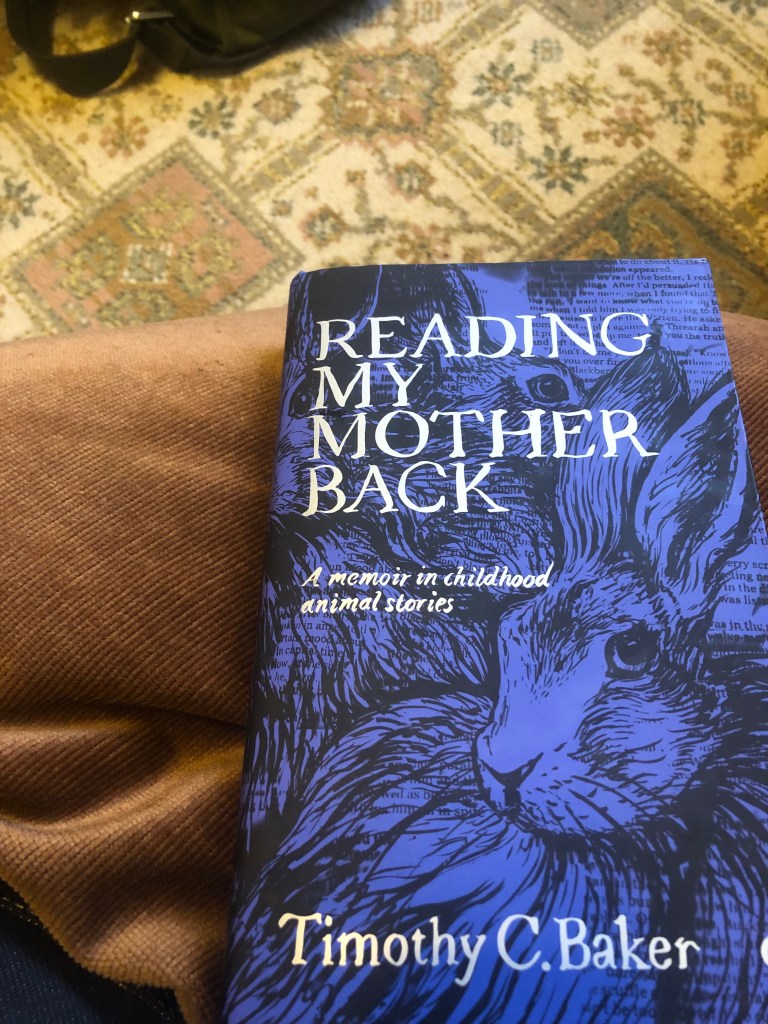
Back again after a significant absence (by the way I finished a draft of my book), to report that, having put it down for a lengthy period (not because I wasn’t enjoying it, just because I suck at reading physical books), I have now finished @tcharlesbaker ‘s memoir and I thoroughly enjoyed it.
Each chapter focuses on a different story (sometimes two) featuring talking animals. I hadn’t heard of 3 of the main 9 and was familiar with another 3, but remembered none of them particularly well. So I learned some stuff about books, was convinced to add some to my reading pile, and loved the memoir bits in between.
Parts of it resonated with me, given that I too have just finished writing about Edith, a very real person: the author’s fear that he is wrongly representing his mother. I constantly fear that I have done Edith some great wrong through writing about her.
But what I mainly took from this book was that the dead have a capacity for returning, for continuing to exist and have a ‘presence’ despite their very real, practical ‘absence’. The author quotes Virginia Woolf, writing about her own mother’s death:
‘But now and again on more occasions than I can number, in bed at night, or in the street, or as I come into the room, there she is; beautiful, emphatic, with her familiar phrase and her laugh […]’
Virginia Woolf also has a connection to Edith, but I shan’t write about it here, because this is supposed to be a book review. Similarly to this quoted passage, Edith is so alive to me, that sometimes I forget, not only how she died, but that she is dead. Sometimes I think I have genuinely grieved for this woman I have never actually met.
Genuine grief – not like what I just described – but real, raw grief, the kind that alters your world, is what this author went through when he lost his mother, and I mean in no way to belittle his very real experience by comparing it with my own for a woman who died before I was born.
I know the author of this book, I am a graduate of both the university he teaches at and the subject he teaches in – and parts of this book felt like I was intruding, like I had no right to read the words on the page – but I, of course do not know his mother. But now I should like to.
At the closing of the book, Baker writes ‘Because I do not want you just to understand my mother; I want you to love her.’
This again resonated, since my book, essentially, had the same goal where Edith is concerned. Mission accomplished.
 The Hopeful Edwardian
Leave a comment