(MAJOR SPOILERS!)
The first time I watched this film I described it as ‘the most endearing pile of chaos I’ve ever watched’. In a sense, I still feel that way. It has an implausibility to it that I can’t shake. Perhaps it’s only endearing if you are a fan of the series and come to the film loving the characters and knowing their stories. There are six series of Downton Abbey (2010 – 2015), and it gained a great following over its time on television.
Who’s Who
Now, it’s hit the big screen and the Crawleys are to be blessed with a ‘royal visit’. Chaos ensues.
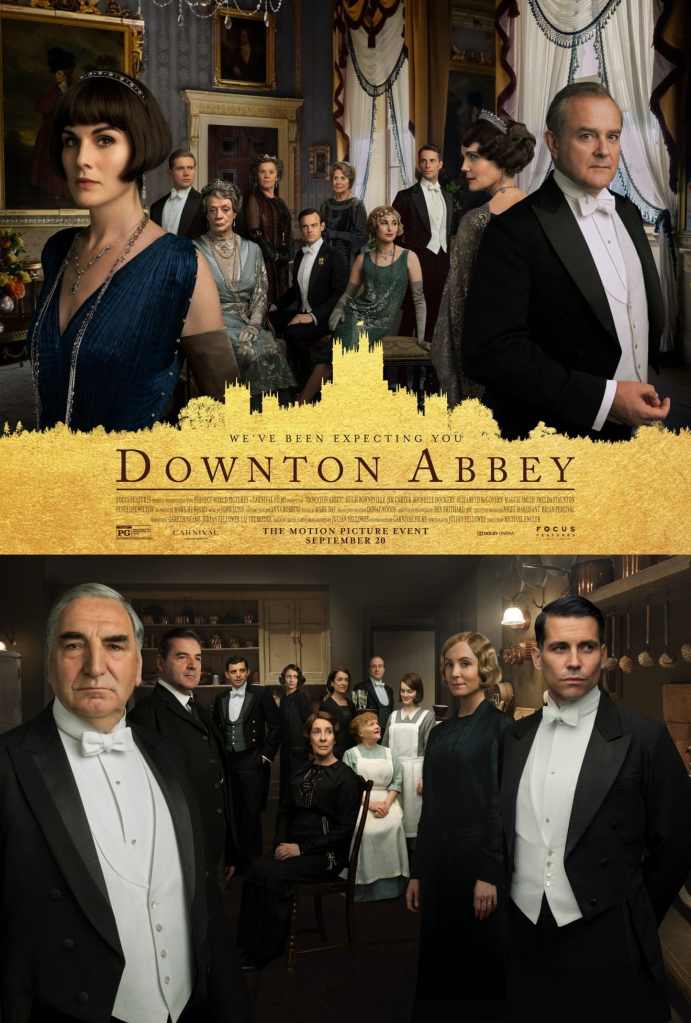
The Crawleys consist of Robert (Hugh Bonneville), Cora (Elizabeth McGovern) and their daughters Mary (Michelle Dockery) and Edith (Laura Carmichael) (who by this point are both married and their husbands also feature). There’s also Robert’s mother Violet, the dowager Countess (Maggie Smith), and Tom Branson, (Allen Leech) an ‘Irish republican’ and husband of the late youngest Crawley daughter Sybil. That’s upstairs.
Downstairs at Downton we have, including but not limited to, Mr Thomas Barrow the butler (Robert James-Collier), Mrs Hughes the housekeeper (Phyllis Logan), the cooks Mrs Patmore and Daisy, (Lesley Nicol and Sophie McShera) Andy the footman, (Michael C. Fox) Anna and Baxter the lady’s maids (Joanne Froggatt and Raquel Cassidy) and Mr Bates (Brendan Coyle) the valet – he and Anna are married.
The news that royalty is coming to Downton is met with mixed reception: Daisy doesn’t think much of the King and admits to republican sympathies but Mr Molesley (Kevin Doyle) (an ex-footman who slips back into his ‘livery’ for the occasion) and Mr Bakewell, owner of the local shop, are ecstatic.
The Story
There are several smaller plotlines within the bigger storyline of the royal visit: the two main ones are arguably that an Irish sympathiser called Major Chetwode (Stephen Campbell Moore) attempts to assassinate the king – but is foiled by Tom, an irony that was not expected by Chetwode as he thought he had found an anti-monarchy ally. The other main one is that the servants rebel, not against their employers but against their treatment by the ‘royal servants’. Feeling ‘humiliated’ and ‘ridden over roughshod’ by the invasion of the royal servants and the fact that they will not be required or allowed to have any role in the royal visit, they cook up a scheme to get rid of the royal staff, led by Anna and Mr Bates.
This film is two hours long, and it packs a lot into that timeframe. Initially, when the visit is announced, we learn that a relative of Robert’s, Maud Bagshaw (Imelda Staunton) who has a rocky relationship with the family (Violet wants her to leave Robert her inheritance and whether or not she will do this is a point of contention between the two women) is in fact the Queen’s lady-in-waiting.
Mary does not trust Thomas Barrow to pilot the visit successfully, so enlists the help of the family’s retired butler Carson (Jim Carter). Carson was a steady and strong presence throughout all six series of the show, only retiring in the final episode and I’m sure I read a YouTube comment where someone said they cried when he reappeared at the abbey.
The royal staff arrive and the servants are not happy about it. Mary, Edith and Cora have tea with Princess Mary (her less-than-harmonious relationship with her husband will form another tendril of plot) and meanwhile Andy is jealous of the flirtatious young plumber who has come to fix the boiler, as he seems keen on Daisy (Andy and Daisy are technically engaged).
With the arrival of the second lot of royal staff, things become genuinely chaotic with disharmony between them and the Downton servants and there being ‘no hot water’ – because Andy got so angrily jealous of the plumber that he attacked the boiler with a shovel.
Upstairs, things are going missing (yet another small plotline) and Mary is struggling to keep all the plates spinning. This involves going out in a thunderstorm (what better weather to mirror chaos) to collect all the folding chairs for the parade the next day.
The next day, at least the weather has cleared up and things look good for Tom when, after ‘seven years, or nearly’ of widowerhood he meets Maud Bagshaw’s maid Lucy Smith (Tuppence Middleton) in the courtyard. The romantic potential is about as subtle as an asteroid.
During the parade, Chetwode attempts to shoot the king but Tom and Mary put a stop to it. Afterward, Tom and Miss Smith meet again.
In the wine cellar, the servants are cooking up their rebellious scheme. Mr Carson is not at all pleased but even he is swept along with it.
Tom is about to be a hero for the second time in one day when he unknowingly gives Princess Mary advice about ‘love[ing] people you disagree with’ and ‘deciding what’s important’.
Get ready for another couple of tiny plots: Thomas (who, I should mention, is gay) has made friends with the King’s valet, Richard Ellis; and Edith is both pregnant and without a dress that fits. Edith has never had much luck (the word on set during the filming of the first series was ‘Poor Edith’) and now even happily married she is to be husbandless when she gives birth because her husband has just been invited on a ‘three-month colonial tour’ with the Prince of Wales.
Remember the missing objects? Well Anna discovers that Miss Lawton, the Queen’s dresser is responsible and in return for not revealing this, gets her to fix Edith’s dress.
Maud Bagshaw reveals that she intends to make Lucy Smith her heir, much to Violet’s horror. Thomas goes to a hidden gay bar and is arrested but Richard Ellis gets him released, and before they part at the film’s conclusion they share a kiss.
Violet’s cousin Isobel (Penelope Wilton), with whom she has an affectionate relationship despite their frequently locking horns, has figured out that Maud Bagshaw is in fact Lucy’s mother and when they tell Violet, she doesn’t approve but is not as shocked as they feared. Tom and Lucy, predictably, share a kiss and finish the film dancing together.
The servants celebrate a successful evening having gotten rid of the royal staff and cooking for and waiting upon the King and Queen themselves. Cora manages to solve Edith’s predicament by speaking with the Queen, Daisy decides that Andy, having confessed to wrecking the boiler, ‘just for the love of [her]’ is definitely marriage material, and Miss Lawton returns the stolen objects.
In a private moment between her and Mary, Violet reveals that she ‘may not have long to live’ – which I am sure devastated fans, Maggie Smith has become the most iconic element of Downton. But she is confident that Mary will carry forward the legacy of Downton into the future, a sentiment Mr Carson shares: ‘a hundred years from now, Downton will still be standing. And the Crawley’s will still be here. And that is a promise.’
What the Audience Thought
Of course, it was (mostly, as put by Rotten Tomatoes) a hit with fans: ‘Downton Abbey distills [sic] many of the ingredients that made the show an enduring favorite, [sic] welcoming fans back for a fittingly resplendent homecoming.’
In a review chiming more with my initial reaction, an article in Radio Times says: ‘What the film lacks is any sense of real jeopardy. As we found out from the trailer, the big plot-line is this: the King and Queen are coming to dinner and Downton must be made perfect! But that simple story is stretched out to a full two hours of incredibly low-stakes, predictable drama with an overabundance of sub-plots.’
I prefer the tv series. The film didn’t quite convince me. Sometimes, while I was watching the series, it was difficult to care about the troubles of a family who compared to many have easy lives, and the film felt like an extended version of that, especially when Mary said, ‘I want everything to stop being such a struggle.’ The Radio Times article mentioned: ‘Also predictably, the Downton movie is very much in love with the King and Queen. Creator and writer Julian Fellowes is clearly a fan of the gang at Buckingham Palace. However, even the most dedicated monarchists, the people who dress as union jacks and camp outside the hospital every time a princess is due to give birth – even they might find this a bit over-the-top.’
Similarly, there will probably be a whole group of people who will have no interest in this film, simply because it is about rich people and royalty. But the fans are loyal and for them, this is simply an extension of something beloved, why would they not watch it.
 The Hopeful Edwardian
Leave a comment